
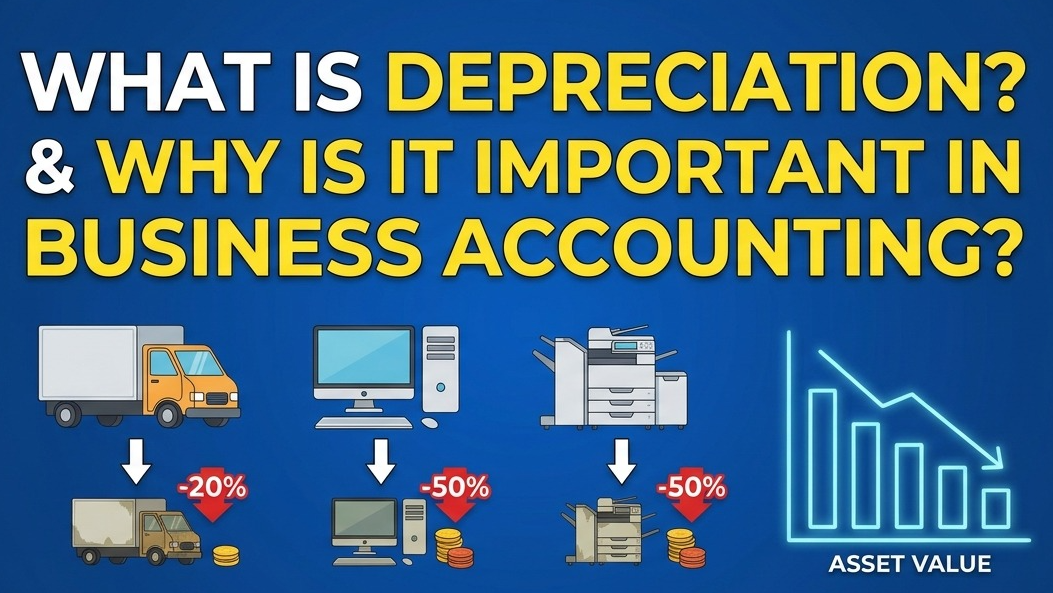
Imagine you buy a delivery van for your business today. It looks brand new, runs perfectly, and helps you deliver products to customers. But after a few years of regular use, the van starts showing signs of wear and tear. Its market value falls, maintenance costs increase, and eventually, it isn’t worth as much as it was on the day you bought it.
The same thing happens with many business assets machines, computers, office furniture, and equipment gradually lose value over time.In accounting, this decrease in value is known as depreciation.
What Is Depreciation?
Depreciation is the accounting method used to allocate the cost of a tangible asset over its useful life. It reflects the gradual reduction in the value of an asset due to factors such as Wear and tear, Regular usage ,Aging and Technological obsolescence Instead of treating the full purchase cost as an immediate expense, businesses recognise the cost over several years. Depreciation helps match an asset’s expense with the revenue it helps generate.
Depreciation means spreading the cost of a long-term business asset over the period it is expected to be used.
Why Do Assets Depreciate?
Most business assets don’t last forever.
They lose value because of several reasons:
1. Wear and Tear –Machines, vehicles, and equipment naturally deteriorate with regular use.
2. Aging -Even if an asset isn’t heavily used, time itself can reduce its value.
3. Technological Changes-Computers, software, and electronic equipment can become outdated as newer technologies emerge.
4. Reduced Efficiency –Older assets may become less productive or require higher maintenance costs.
Which Assets Can Be Depreciated?
Businesses generally depreciate tangible fixed assets that have a useful life of more than one year.
Examples include -Machinery ,Factory equipment ,Delivery vehicles ,Office furniture ,Computers and laptops ,Buildings (excluding land) andManufacturing tools
Which Assets Are Not Depreciated?
Some assets are usually not depreciated.
Examples include -Land ,Inventory ,Cash and bank balances and Investments held for short-term trading
These assets either don’t lose value in the same way or are treated differently under accounting rules.
How Is Depreciation Calculated?
There are several methods, but the most common is the Straight-Line Method.
The formula is
Asset Cost -The original purchase price of the asset.
Residual Value -The estimated value of the asset at the end of its useful life. It is also called the salvage value.
Useful Life -The period over which the business expects to use the asset.
Example
Imagine a company buys a machine for:
Purchase Price: 5,00,000
Residual Value: 50,000
Useful Life: 5 years
Using the straight-line method:
Annual Depreciation:
(5,00,000 − 50,000) ÷ 5 = 90,000 per year
This means the business records ₹90,000 as depreciation expense every year for five years.
Why Is Depreciation Important?
1. Provides a More Accurate Profit Figure –If a business records the full cost of an expensive asset immediately, profits may appear unusually low in that year. Depreciation spreads the expense over time, giving a fairer view of earnings.
2. Matches Expenses with Revenue –Assets help generate revenue for several years. Depreciation ensures that the related expense is recognized over the same period.
3. Helps in Financial Reporting –Depreciation is an essential part of preparing accurate financial statements. Investors and lenders rely on these reports to assess business performance.
4. Supports Tax Planning –In many jurisdictions, depreciation expenses can reduce taxable income according to applicable tax laws. This may lower the tax burden for businesses.
5. Assists in Asset Replacement Planning –Tracking depreciation reminds businesses that assets eventually need replacement. It encourages better long-term financial planning.
Common Methods of Depreciation
Straight-Line Method –The same amount of depreciation is charged every year. It is simple and widely used.
Declining Balance Method –Higher depreciation is recorded in the early years of the asset’s life. The expense gradually decreases over time.
Units of Production Method –Depreciation depends on how much the asset is actually used. Suitable for machinery with measurable output.
Depreciation vs Maintenance: What’s the Difference?
Many people confuse these two concepts.
| Depreciation | Maintenance |
| Reduction in asset value over time | Cost of keeping the asset operational |
| Accounting expense | Actual operating expense |
| Non-cash expense | Cash expense |
| Reflects aging and usage | Covers repairs and servicing |
For example -Depreciation records the gradual loss in value of a delivery truck. Maintenance covers oil changes, repairs, and servicing costs.
Common Misconceptions About Depreciation
Depreciation Means Money Leaves the Business –Not exactly. Depreciation is a non-cash expense. The cash was spent when the asset was purchased.
Every Asset Depreciates –Assets like land are generally not depreciated because they don’t usually have a limited useful life.
Depreciation Reduces Cash Flow –Depreciation reduces accounting profits but does not involve a current cash outflow.
Small Businesses Don’t Need to Track Depreciation –Even small businesses benefit from understanding asset costs and planning for replacements.
Interesting Facts About Depreciation
- Depreciation has been a part of accounting practices for more than a century.
- Two companies with identical profits can report different earnings because they use different depreciation methods.
- Depreciation affects both the income statement and the balance sheet.
- It is one of the reasons why accounting profit and cash flow are not always the same.
- Investors often examine depreciation expenses to understand how asset-intensive a business is.
Final Thoughts
Depreciation may sound like a technical accounting term, but the idea behind it is simple.
Businesses use assets for many years, and those assets gradually lose value over time. Instead of recording the entire cost at once, depreciation spreads that cost across the asset’s useful life.
This approach helps businesses present more accurate financial statements, measure profits fairly, plan for future asset replacements, and comply with accounting requirements.
Because in business, buying an asset isn’t just a one-time event—it’s a resource that contributes to operations over many years.
And depreciation helps tell that story accurately.
FAQs
What is depreciation in simple terms?
Depreciation is the process of spreading the cost of a tangible asset over its useful life.
Why is depreciation important?
It provides a more accurate picture of profits and helps businesses match expenses with revenue.
Is depreciation a cash expense?
No. It is a non-cash accounting expense.
Which assets can be depreciated?
Tangible assets such as machinery, vehicles, furniture, and computers can generally be depreciated.
Is land depreciated?
No. Land is generally not depreciated because it usually does not have a limited useful life.