
Tag: Break-even point formula

  • What Is a Break-Even Point and Why Is It Important for Every Business?
    What Is a Break-Even Point and Why Is It Important for Every Business?

    Imagine you’ve just opened a small cafe. You’ve invested money in renting the space, buying coffee machines, hiring staff, and stocking up on ingredients. Customers start walking in, and sales begin to pick up.

    At what point does your business stop recovering costs and actually start making a profit? That’s exactly what the break-even point helps you understand.

    Whether you’re running a startup, a small business, or planning to launch a new product, knowing your break-even point can help you make smarter financial decisions. It tells you the minimum amount you need to sell to cover all your costs no profit, no loss.

    What Is a Break-Even Point?

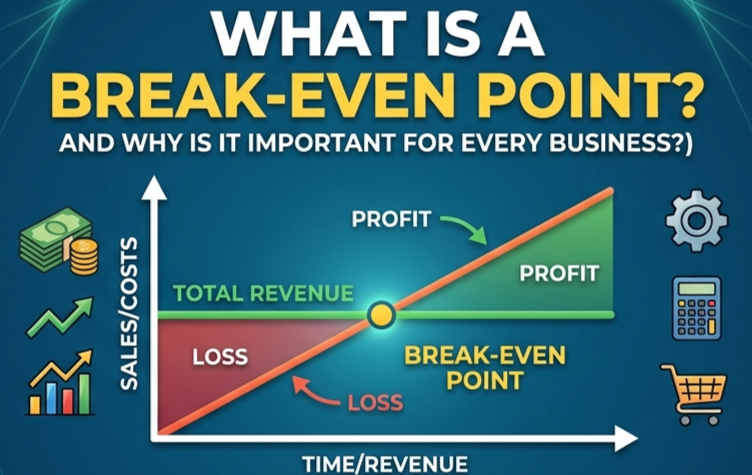
    The break-even point is the stage at which a business’s total revenue equals its total costs. At this point, the business is not making a profit, but it is not incurring a loss either. In simple words, it is the point where the business has recovered all of its expenses. Any sales made after reaching the break-even point contribute to profit.

    Break-even is the moment your business moves from recovering costs to earning profits.

    Understanding the Key Terms

    Fixed Costs

    Fixed costs are expenses that remain the same regardless of how much you sell.

    Examples include Rent ,Salaries of permanent staff ,Insurance ,Loan repayments ,Software subscriptions and Property taxes Whether you sell one product or one thousand products, these costs usually stay constant.

    Variable Costs

    Variable costs change depending on production or sales volume.

    Examples include –Raw materials ,Packaging ,Delivery charges ,Sales commissions and Production labour tied directly to output .The more you produce or sell, the higher these costs become.

    Selling Price Per Unit

    This is the amount charged to customers for each product or service sold.

    For example – If you sell a cake for 500, your selling price per unit is 500.

    A Simple Break-Even Example

    Imagine you own a bakery.

    Fixed Costs -Monthly rent: 30,000 ,Staff salaries: 20,000 Total Fixed Costs = 50,000

    Per Cake -Selling Price = 500 Variable Cost = 300

    Contribution per cake  =500 − 300 = 200

    Break-Even Point  = 50,000 ÷ 200 = 250 cakes

    This means ,You must sell 250 cakes in a month to cover all your costs.The 251st cake is where profit begins.

    Why Is the Break-Even Point Important?

    1. Helps Determine Profitability –The break-even point shows exactly how much a business needs to sell before earning profits. It gives owners realistic financial expectations.

    2. Supports Better Pricing Decisions -If the break-even point seems too high, businesses may reconsider pricing strategies. Adjusting prices can improve profitability.

    3. Helps Control Costs –Understanding how fixed and variable costs affect break-even encourages businesses to manage expenses more efficiently.

    4. Reduces Financial Risk –Knowing the minimum sales target helps businesses prepare for slower periods and avoid surprises.

    5. Assists in Business Planning – Entrepreneurs often use break-even analysis before launching New products ,New branches ,Startups and Expansion plans

    Benefits of Knowing Your Break Even Point

    Better Goal Setting -Businesses can establish clear sales targets.

    Improved Decision-Making -Owners can evaluate whether a product or project is financially viable.

    Greater Confidence –Understanding the numbers reduces uncertainty and supports informed decisions.

    Stronger Budgeting -Break-even analysis helps create more realistic financial plans.

    How Businesses Use Break-Even Analysis

    Companies regularly use break-even analysis to answer questions like –

    • How many units do we need to sell this month?
    • Should we increase prices?
    • Can we afford to hire more employees?
    • Is launching this product worth the investment?
    • How will rising costs affect profitability?

    What Happens After the Break-Even Point?

    Once the break-even point is reached –

    • Fixed costs have been covered.
    • Variable costs continue with each sale.
    • Additional revenue begins contributing to profit.

    For example

    If your break-even point is 250 cakes

    Selling 250 cakes = No profit, no loss.

    Selling 300 cakes = Profit on the additional 50 cakes.

    This is why many businesses closely track their sales against break-even targets.

    Factors That Affect the Break-Even Point

    Changes in Fixed Costs -Higher rent, salaries, or insurance increase the break-even point.

    Changes in Variable Costs -Rising raw material costs mean more sales may be needed to break even.

    Changes in Selling Price  -Increasing prices can lower the break-even point. Reducing prices may require higher sales volumes.

    Sales Volume –The speed at which products sell directly affects how quickly a business reaches break-even.

    Common Mistakes Businesses Make

    Ignoring Fixed Costs -Businesses sometimes underestimate expenses that occur regardless of sales.

    Setting Prices Too Low -Low pricing may attract customers but make profitability difficult.

    Forgetting Variable Costs -Every sale often comes with additional costs that must be considered.

    Treating Break-Even as the Final Goal -Breaking even is an important milestone, but long-term success requires consistent profitability.

    Interesting Facts About Break-Even Points

    • Many startups calculate their break-even point before officially launching.
    • Investors often review break-even analysis when evaluating business plans.
    • Seasonal businesses may have different break-even points throughout the year.
    • A lower break-even point generally provides greater flexibility during economic downturns.
    • Understanding break-even can help businesses avoid expanding too quickly.

    Final Thoughts

    The break-even point is one of the most practical financial concepts every business owner should understand. It tells you exactly how much you need to sell to recover your costs and begin generating profits.

    By understanding fixed costs, variable costs, and pricing, businesses can set realistic goals, reduce financial risks, and make more informed decisions.

    Because before a business can dream about big profits and expansion, it first needs to answer one simple question How much do we need to sell just to stay afloat?

    The break-even point provides that answer and that’s why it remains one of the most valuable tools in business planning.

    FAQs

    What is a break-even point in simple terms?

    It is the point where a business’s total revenue equals its total costs, resulting in no profit and no loss.

    Why is the break-even point important?

    It helps businesses understand how much they need to sell before earning profits.

    What costs are included in break-even analysis?

    Both fixed costs and variable costs are considered.

    Can the break-even point change?

    Yes. Changes in costs, pricing, or production levels can affect it.

    Does reaching the break-even point mean the business is profitable?

    No. It simply means all costs have been covered. Profit begins only after sales exceed the break-even point.